

Innovations in End-of-Arm Tooling (EOAT) for Plastics Processing
In the rapidly evolving world of plastics processing, manufacturers are constantly seeking new ways to boost efficiency, maintain high quality standards, and minimize waste. One of the most transformative elements in modern automation is End-of-Arm Tooling (EOAT)—the critical component of a robotic arm that interacts directly with the product. Recent innovations in EOAT designs and sensor technologies are redefining what’s possible in plastics packaging, especially in areas like injection molding, thermoforming, and blow molding.
Smarter, Lighter, More Versatile: Advancements in EOAT Design
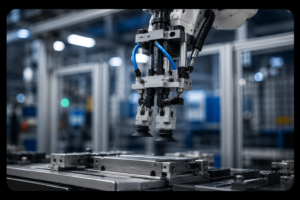
Modern EOAT is no longer a one-size-fits-all mechanical gripper. Today’s tools are modular, lightweight, and application-specific, often created using advanced materials such as carbon fiber composites or 3D-printed polymers that reduce weight without sacrificing strength. This weight reduction allows robots to operate faster and with greater precision while also reducing wear on mechanical systems.
Key design trends include:
- Quick-change systems: Enable rapid switching between different EOATs for various product lines.
- Soft grippers and adaptive fingers: Allow for gentle handling of fragile or oddly shaped plastic items.
- Integrated vacuum and mechanical hybrid systems: Deliver better control over complex parts, especially in packaging applications with varying surface textures or sizes.
Embedded Intelligence: Sensor Integration in EOAT
Sensor technology is transforming EOAT from passive grippers to intelligent manipulators. These sensors provide real-time data and feedback that enhance precision and reliability during the plastics handling process.
Notable advancements include:
- Force and torque sensors that ensure gentle handling of delicate products or verify that parts are fully gripped.
- Proximity and vision sensors to guide EOAT positioning and orientation, reducing misalignment and cycle times.
- Temperature and pressure sensors integrated into EOAT used in injection molding processes, helping verify that molded parts are ready for removal without damage.
The fusion of EOAT with machine learning algorithms and edge computing also enables adaptive handling strategies, allowing the tooling to automatically respond to changes in part geometry, orientation, or material properties.
Real-World Impact: Case Studies in Plastics Packaging
Case Study 1: High-Speed Injection Molding in Beverage Caps
A European packaging manufacturer integrated a new EOAT system featuring multi-cavity grippers with embedded vacuum sensors to handle plastic caps produced at over 100 parts per minute. The EOAT monitored part presence and grip status in real time, virtually eliminating part ejection errors and reducing mold damage caused by improper removal. This innovation led to a 15% increase in uptime and a 25% reduction in scrap.
Case Study 2: Thermoformed Tray Packaging
In an Asian facility producing plastic trays for food packaging, a robotic EOAT with 3D-printed adaptive grippers and force sensors was introduced. The EOAT adjusted in real time to compensate for variations in tray shape due to material shrinkage. The result was a significant improvement in product consistency and a 30% drop in rejected units due to deformation or damage.
Case Study 3: Blow Molded Container Handling
A U.S.-based manufacturer of blow-molded HDPE containers upgraded its EOAT to include vision-guided pick-and-place tools with edge detection algorithms. This enabled precise placement of containers onto conveyors and reduced toppling issues. With the new system, line speed increased by 20%, and post-molding defect detection improved due to enhanced part orientation accuracy.
Conclusion: EOAT as a Competitive Advantage
Innovations in EOAT are proving to be more than just engineering upgrades—they’re becoming strategic assets in plastics processing. From minimizing downtime and waste to improving part quality and operational flexibility, the latest EOAT advancements empower manufacturers to meet evolving demands in packaging design, speed, and sustainability.
As automation continues to evolve, so too will the tools at the end of the robotic arm. For companies in the plastics industry, keeping pace with EOAT innovation is no longer optional—it’s essential.